Tips & Guides
How Much Mulch Do I Need? A Simple Garden Bed Guide
How much mulch do I need is one of those questions that stops a Saturday project before it starts. You know the beds need doing, you know mulch comes in cubic metres, and somewhere between those two facts is a sum nobody wants to do standing in a driveway.
It is genuinely simple once you have seen it once. Here is the whole thing.
How much mulch do I need?
Multiply the area of your beds in square metres by the depth you want in metres. That is the entire calculation. A 20 square metre bed at 50mm deep is 20 × 0.05, which is 1 cubic metre.
Two more worked examples so it sticks:
- A bed 3m long by 2m wide is 6 square metres. At 75mm deep, that is 6 × 0.075, or about 0.45 cubic metres.
- Forty square metres of beds at 75mm deep is 40 × 0.075, which is 3 cubic metres.
Round up, always. Nobody in the history of gardening has finished a job and wished they had ordered less mulch.
How deep should mulch be?
For most Sydney garden beds, 75mm is the sweet spot. It is deep enough to hold moisture and smother weed seedlings, and not so deep that water struggles to get through to the roots.
Adjust from there:
- 50mm for annual beds and beds already packed with established plants.
 Close-up shot of vibrant red wood mulch, ideal for gardening and design projects.
- 75mm for the standard mixed garden bed. This is what we lay most often.
- 100mm for native gardens, sloped beds, or anywhere weeds are the main enemy.
Going much past 100mm stops being helpful. Very deep mulch can shed light rain rather than let it soak in, which is the opposite of the point.
How many square metres does a cubic metre of mulch cover?
At 75mm depth, one cubic metre covers roughly 13 square metres. At 50mm you get about 20 square metres out of it, and at 100mm about 10.
Handy for a sanity check. If a supplier's calculator tells you something wildly different from those figures, one of you has the depth wrong.
How do I measure an odd shaped garden bed?
Break it into rectangles and add them up. Almost every real garden bed is a couple of rectangles and a curve, and treating the curve as a rectangle slightly overestimates, which is exactly the direction you want to be wrong in.
A tape measure and the notes app on your phone beats guessing by a mile. If you would rather not, most landscape suppliers publish a mulch calculator that does the sum for you once you have the measurements.
Should I order in bags or bulk?
Bags suit small jobs and boots, bulk suits anything over about a cubic metre. Bags are easy to store, easy to carry through a side gate, and get expensive fast once you need more than a handful. Bulk delivered to the driveway is far better value at volume, but it arrives as a pile and it does not move itself.
 Top view of wooden boxes with piles of firewood wood chips sawdust and coal placed on ground in agricultural plantation
Worth a thought before you order: where will the pile go, will it block the cars, and who is doing the barrow runs. That last question has ended more than one weekend project.
What kind of mulch is best for Sydney gardens?
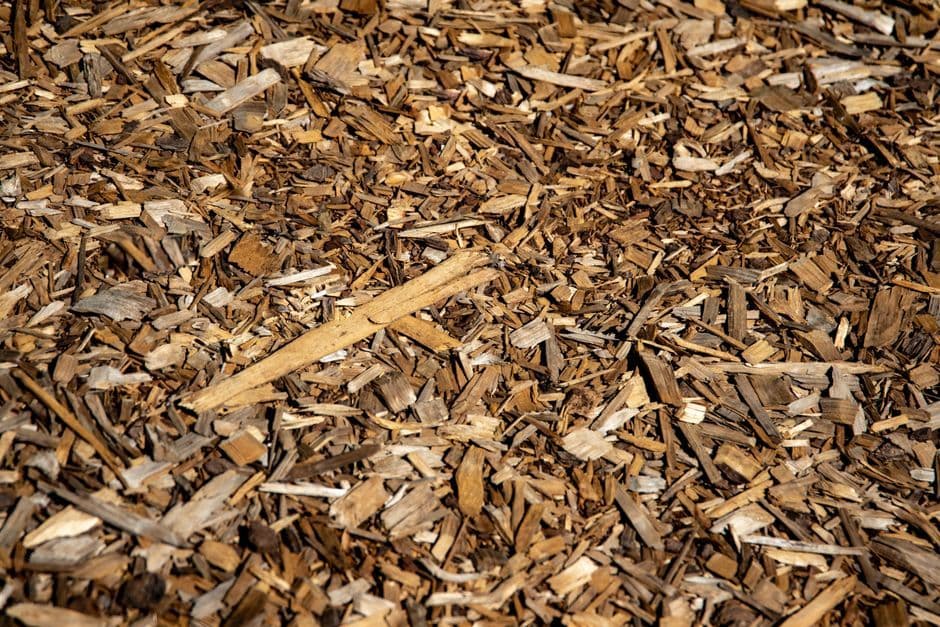
For general garden beds, a coarse chunky organic mulch such as a hardwood chip or bark works best because it breaks down slowly and does not blow away. Finer mulches look tidier on day one and knit into a mat that can repel water after a few months.
Sugar cane and lucerne are great around veggies and annuals where you actually want fast breakdown feeding the soil. For native beds, a leaf and bark blend suits both the look and the plants.
When is the best time to mulch?
Late winter into early spring is ideal, before the weeds get going and ahead of the first hot spell. Mulching in August or September means the beds are protected before they need to be, rather than after.
Autumn is the other good window. The one to avoid is topping up in the middle of a heatwave onto bone dry soil, because you are then sealing the dryness in. Water the beds first, then mulch.
Do I need to remove the old mulch first?
Usually not. If the existing layer has broken down and thinned out, rake it over to break up any crust and top up to depth. Only strip it back if it has gone matted and water repellent, or if it has developed a solid fungal crust.
One thing to get right either way: keep mulch back a few centimetres from plant stems and tree trunks. Piled against a trunk it holds moisture where you least want it and invites rot.
The short version
Area times depth, round up, 75mm for most beds, keep it off the stems, and do it before spring rather than after. Mulching is one of those jobs that pays you back all summer in water saved and weeds that never showed up. Check the current watering rules with Sydney Water while you are at it, because a well mulched bed needs a lot less from the hose.
If you would rather it just appeared, done properly, with the beds edged and the mess taken away, that is part of what our garden maintenance service covers. Ask us for a quote and we will measure the beds ourselves. More garden guides here if you are doing it yourself.
Get an honest quote for your place
A free quote, no obligation, and the price we give is the price you pay.